

Before you can name a tree, you need to know what you are looking at. Leaf identification comes down to three main features: the overall shape of the leaf, how it is arranged on the twig, and the type of edge or margin. Get those right and most common British trees will fall into place quickly.
Shape means whether a leaf is lobed, oval, triangular or divided into leaflets. Arrangement is either alternate (leaves and buds staggered along the twig) or opposite (leaves and buds sitting in pairs directly across from each other). Margin describes the edge: smooth, toothed, wavy or lobed. A hand lens helps, but your eyes will do for most species.
Oak is the easiest to recognise once you know what to look for. English oak (Quercus robur) has leaves that are deeply lobed with rounded edges. The lobes are irregular, and there is no bristle tip at the end of each lobe. Leaves are roughly 5–15 cm long and grow in clusters at the ends of twigs, with an alternate arrangement along the branch.
Turn a leaf over and you may see small tufts of hair in the vein axils – a useful detail. Sessile oak leaves are similar but have a longer leaf stalk and the lobes are more regular. Both are common in British woodland, hedgerows and parkland. If you find an acorn nearby, you are almost certainly looking at an oak.
Ash (Fraxinus excelsior) is the tree to check when you see opposite buds. Its leaves are pinnate, meaning they are made up of several leaflets arranged along a central stem. You will usually count 7–13 leaflets, each one lance-shaped with a toothed margin. The leaflets are opposite each other along the stem, and the terminal leaflet is often slightly larger.
The whole leaf can be 20–30 cm long, so it looks quite different from a simple oak or beech leaf. Ash twigs are smooth and pale grey, and the buds are black – a dead giveaway in winter. In summer, look for the opposite arrangement: if you can slide your fingers up the twig and leaves meet in pairs, it is ash or field maple, not oak or beech.
Beech (Fagus sylvatica) leaves are oval, roughly 6–10 cm long, with a wavy margin that is fringed with soft hairs when the leaf is young. The veins run parallel from the midrib to the wavy edge, giving a pleated look. Leaves are alternate on the twig and have a short stalk. In autumn they turn a rich copper colour and often stay on the tree well into winter, especially on younger trees.
Beech is often confused with hornbeam, which has a similar wavy edge but more sharply toothed margins and a hop-like seed cluster. If the leaf feels silky underneath and the bark is smooth and grey, think beech. The leaf buds are long, slender and sharp-pointed, arranged alternately.
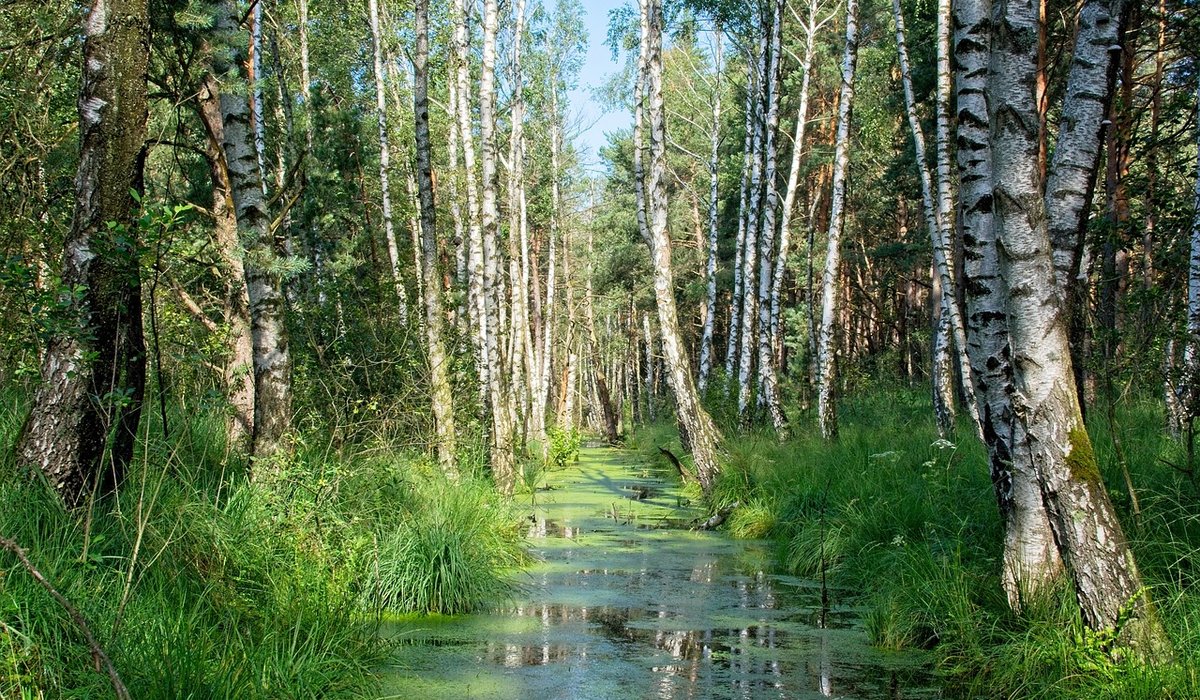
Birch (Betula species) has small, triangular or diamond-shaped leaves, usually 3–6 cm long. The margin is doubly toothed, meaning the teeth themselves have smaller teeth. Leaves are alternate, light green, and turn yellow in autumn. Silver birch leaves are hairless and have a tapered tip, while downy birch leaves are softer and more rounded at the base.
The easiest clue is the tree itself: silver birch has peeling white bark, and downy birch has browner, less peeling bark. Both have drooping catkins in spring. If you see small triangular leaves on a twig with tiny winged seeds, you are looking at birch.
Practice on a single tree before you try a whole woodland. Pick a leaf, then check the twig: are the leaves opposite or alternate? Next, look at the margin with your thumb – is it lobed, toothed or smooth? Finally, look at the overall shape. With oak, ash, beech and birch under your belt, you will recognise most British woodland trees you meet.
Take a pocket guide and a notebook. Sketch the leaf shape and note the arrangement – you will learn faster than by photographs alone. And remember: a tree is more than its leaves, so check the bark, buds and seeds too. Happy tree spotting.

Birchbulletin Real stories, useful guides and the occasional recommendation, all in one calm corner of the web.

Birchbulletin No rushing, no fuss — just thoughtful notes and practical help, written by people who care.

Choose the right spot, prepare the soil and water young birches carefully. These steps help new trees settle into British gardens.

Comments
ALina Kelian
19th May 2018 ReplyBirchbulletin Simple, genuine and looked after with care — the kind of place worth returning to. ullamco laboris nisi ut aliquip ex ea commodo consequat.
Rlex Kelian
19th May 2018 ReplyBirchbulletin No rushing, no fuss — just thoughtful notes and practical help, written by people who care. ullamco laboris nisi ut aliquip commodo.
Roboto Alex
21th May 2018 ReplyBirchbulletin Real stories, useful guides and the occasional recommendation, all in one calm corner of the web. ullamco laboris nisi ut aliquip ex ea commodo consequat.